¶ 🚨 No Scan (Unregistered Movement) – EASiNOP
Updated: July/2026
Intelligent video auditing for the checkout lane: identifies products that pass through the checkout without appearing on the receipt.
¶ What is EASiNOP?
EASiNOP is an intelligent video auditing system that helps the store identify possible losses at the checkout, analyzing situations where a product:
- physically passes through the checkout
- but does not appear on the sales receipt
It acts as an additional control layer at the checkout lane, providing objective visibility for management and the loss-prevention team, without interfering with POS operation.
¶ What the system delivers to the store
With EASiNOP, the store gains:
- Automatic alerts for possible Unregistered Movements (No Scan)
- Detailed history by checkout, operator, date, and time
- More focus on prevention, pointing to where it's really worth investigating
- Support for management, based on objective data and video evidence
The system does not replace management or the operator — it provides clear information to support decision-making.
¶ How it works (simple view)
EASiNOP compares two pieces of information at the same time:
- The actual movement of hands and products, captured by the cameras
- The records from the sales system (receipt)
Whenever the system identifies a physical product-exit movement but does not find that item recorded on the receipt, it generates an alert for a possible Unregistered Movement (NOP / No Scan).
¶ How the system "sees" the checkout
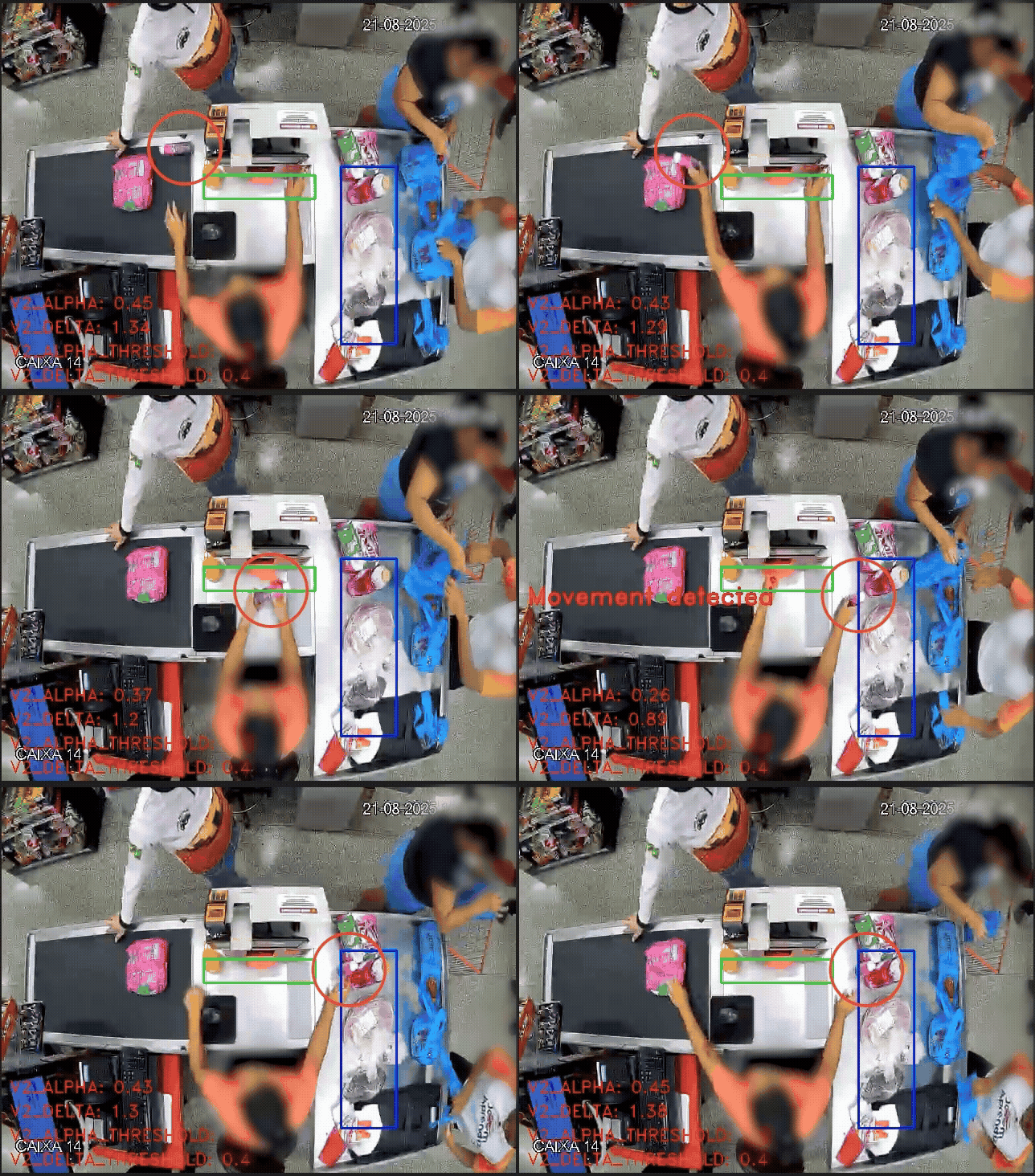
It works based on two well-defined areas in the video, configured according to each POS layout:
¶ Scanning Area (P1)
Where the operator passes the product for scanning and registration at the checkout.
¶ Delivery / Exit Area (P2)
Where the product is placed after registration, usually toward the customer.
Basic detection logic: if there is product movement from the Scanning Area (P1) to the Delivery Area (P2) without a receipt record, the system generates an alert.
¶ Current Detection Rule (Very Important)
Currently, EASiNOP performs detection based on the SALES RECEIPT.
- There is only one Unregistered Movement alert per receipt
- Even if several irregular movements occur in the same transaction, the system consolidates them into a single alert
This model was intentionally adopted to:
- Ensure accuracy
- Avoid an excess of repeated alerts (noise)
- Make analysis easier for the store team
Future updates may expand this logic, but for now the standard is: 1 alert per receipt.
¶ Important conditions for correct operation
For the analysis to reflect real operation, a few points must be respected.
¶ Prerequisites
- There must be an open receipt at the moment of the movement
- The system considers a real sale, in normal operation
- Only one No Scan event is considered per receipt
¶ Operational points of attention
- The checkout operation method directly influences detection
- Movements such as wiping the counter, handling bags, or objects crossing the areas while the receipt is open can be detected
- Tests done with a canceled receipt do not represent the system's real behavior
These scenarios are not system failures, but rather operating conditions that influence video reading.
¶ What is considered normal operation
In video-analysis systems, some behaviors are expected:
- Occasional false positives, especially in atypical movement situations
- An operator change can temporarily alter the movement pattern
- Poorly adjusted areas can initially generate improper alerts
These points are usually resolved with:
- Fine-tuning of the detection areas
- Small calibrations
- Monitoring of the store's real usage
¶ Conclusion
No Scan – EASiNOP is a prevention and auditing tool, designed to support checkout operation with clear, objective, and auditable data.
It does not accuse, does not interfere, and does not block sales — it observes, records, and informs, allowing management to act based on facts and evidence.